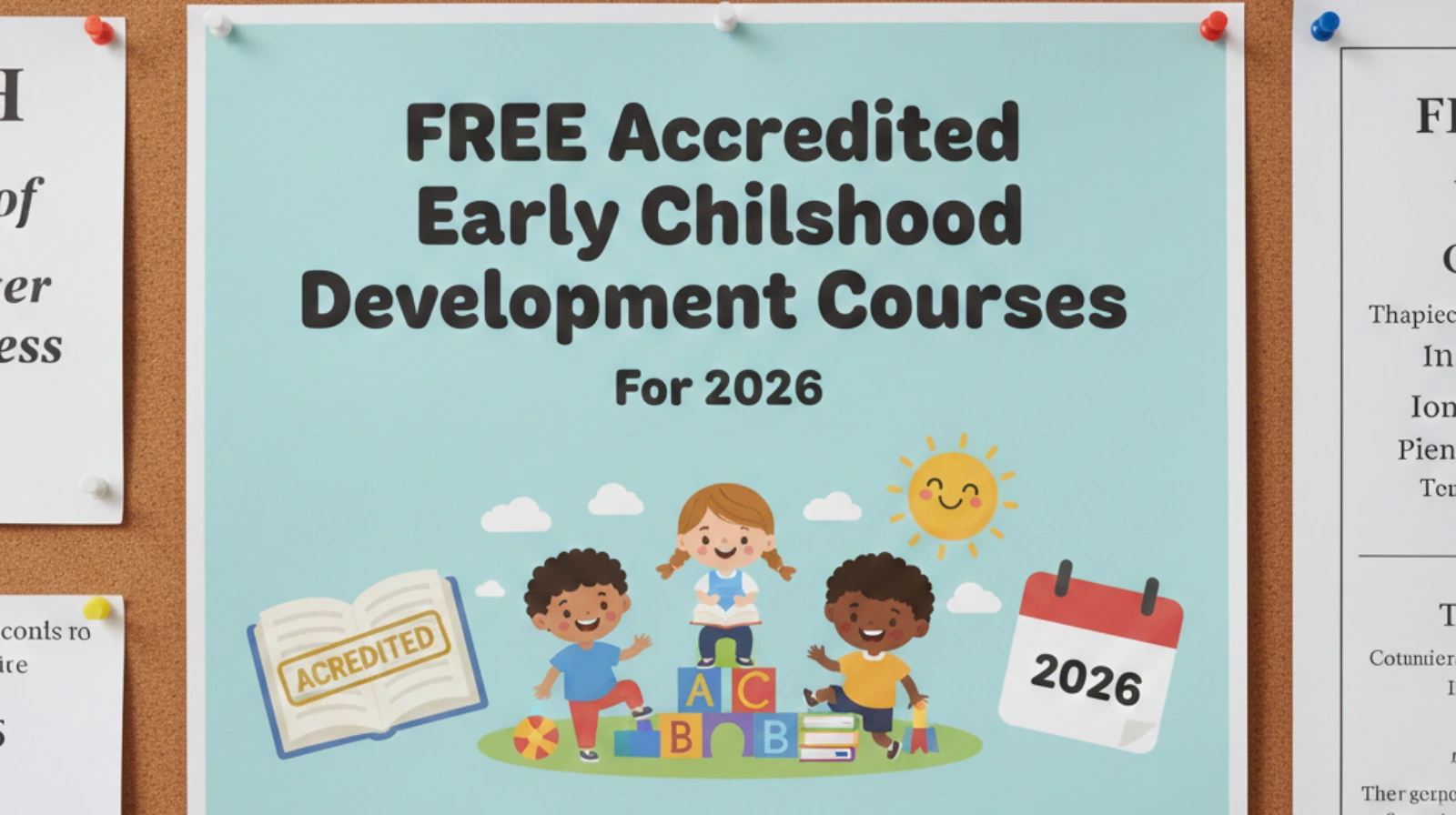
FREE ACCREDITED EARLY CHILDHOOD EDUCATION COURSES (2026)
This guide outlines legitimate, accredited, and fully funded pathways to becoming a certified Early Childhood Development (ECD) practitioner or educator in 2026.
🌍 1. Global Online Certifications (Free & Accredited)
These platforms offer self-paced learning from world-class institutions. While the courses are free, some may require a small fee for a physical certificate, though digital versions are often free or can be subsidized.
OpenLearn (The Open University)
- Best for: University-level academic foundational knowledge.
- Key Courses: * Supporting Physical Development in Early Childhood
- Exploring the Impact of Hope and Love on Early Childhood Development
- Accreditation: Badged Open Courses (BOCs) provide a digital badge and a Statement of Participation.
- Link: OpenLearn Education
Childhood Education International
- Best for: Educators in specialized or emergency settings.
- Key Courses:
- Early Childhood Inclusive Environments & Universal Design for Learning (Spring 2026)
- Action Research for Early Childhood Educators (March 2026)
- Accreditation: Offers professional certificates.
- Link: CE International Courses
Swayam (India / Global Access)
- Best for: Comprehensive, semester-long curriculum.
- Course: Early Childhood Care and Education (15-week duration).
- Accreditation: Government-backed (India), valid for credit transfer in many regions.
- Link: Swayam ECE
🇿🇦 2. Fully Funded Learnerships & Stipends (South Africa Focus)
For 2026, the South African government and various NGOs have expanded “Earn while you Learn” programs.
The PLAY Online Course (playsa.org)
- Target: Practitioners, childminders, and Foundation Phase teachers.
- Benefit: 100% Free; earners receive 15 CPD credits endorsed by SACE (South African Council for Educators).
- Focus: Play-based learning and the National Curriculum Framework (NCF).
- Link: PlaySA.org
National ECD Learnership Programme 2026
- Funding: ETDP SETA and Department of Social Development.
- Qualification: Occupational Certificate: ECD Practitioner (NQF Level 4 or 5).
- Perks: Zero tuition fees + Monthly Stipend (approx. R3,000 – R4,500).
- Application Portals:
- SA Youth (Harambee): SAYouth.mobi (Keep your profile updated every 2 weeks).
- SmartStart: Focuses on home-based micro-enterprise training. SmartStart.org.za
🛡️ 3. Safety & Professional Development (Short Courses)
Essential for licensing and compliance in any childcare environment.
| Provider | Course
Title |
Accreditation | |
|---|---|---|---|
| CDC | Watch Me!
Celebrating Milestones |
0.1 CEUs | |
| ProSolutions | Trauma-Informed Care | 0.5 CEUs | |
| First Aid for Free | Pediatric First Aid | Certificate of Completion | |
| Mental Health Tech | Classroom WISE (Mental Health) | Certificate of Completion |
📝 4. Application Checklist for 2026
To secure a spot in funded programs, prepare these digital copies:
- Certified ID: Must not be older than 3 months.
- Highest Qualification: Grade 10, 11, or Matric Certificate.
- Updated CV: Highlight any volunteer work with children or community projects.
- Police Clearance: Essential for working with minors (required by most 2026 intakes).
The Benefits of ECD Learnership Courses
Taking an Early Childhood Development (ECD) Learnership offers a unique pathway into the education sector. Unlike traditional academic routes, learnerships prioritize workplace exposure while ensuring you meet national standards.
1. Professional and Career Advantages
- Nationally Recognized Qualifications: Most learnerships lead to NQF Level 4 (Further Education and Training Certificate) or NQF Level 5 (Higher Certificate/Diploma) qualifications. These are accredited by ETDP SETA and recognized across South Africa.
- Enhanced Employability: Graduates are highly sought after by preschools, crèches, daycares, and NGOs. A formal qualification provides the “professional credibility” that many informal practitioners lack.
- Practical Work Experience: You don’t just study; you work. Learners gain hands-on experience in real classrooms under the mentorship of qualified educators, which is often more valuable to employers than theory alone.
- Pathways to Further Study: An ECD Level 5 qualification can serve as a stepping stone toward a Bachelor of Education (BEd) in Foundation Phase Teaching, allowing you to move into formal primary school teaching.
2. Financial Benefits
- Earn While You Learn: Most learnerships provide a monthly stipend (typically ranging from R2,500 to R4,000+) to assist with travel and living costs.
- No Tuition Fees: Unlike university degrees, SETA-funded learnerships are generally free for the learner, making them accessible to unemployed youth and those from low-income backgrounds.
- Job Security: The South African government has prioritized ECD by moving its oversight to the Department of Basic Education (DBE), increasing the demand for qualified practitioners in both public and private sectors.
3. Essential Skills Gained
- Child Development Knowledge: Understanding the psychology of how children grow physically, cognitively, and emotionally.
- Curriculum Planning: Learning to design age-appropriate activities and “play-based” learning programs that prepare children for formal schooling.
- Health and Safety: Training in first aid, child nutrition, hygiene routines, and identifying signs of child abuse or neglect.
- Classroom Management: Developing techniques to manage group dynamics, address behavioral issues, and create a safe, stimulating environment.
4. Personal Growth and Social Impact
- Shaping the Future: ECD practitioners play a vital role in “school readiness.” Research shows that quality early intervention significantly improves a child’s lifelong academic and economic success.
- Soft Skill Development: You will develop high levels of patience, empathy, communication, and organizational skills.
- Uplifting Communities: Many learners work within their own communities, helping to bridge the educational gap for underserved children and providing support to local families.
Summary of Career Roles
With an ECD Learnership qualification, you can work as an:
- ECD Practitioner / Lead Teacher
- Assistant Teacher / Grade R Aide
- Crèche Manager or Owner
- Child Development Consultant
- NGO Program Facilitator
⚠️ SCAM ALERT
- NEVER pay a “registration fee” or “placement fee” for a learnership.
- Verify training providers through the ETDP SETA or your local Department of Education.